除了建立物件,建構函數(constructor)還默默做了另一件重要的事:自動為新物件設定原型物件(prototype object),並存放於 ConstructorFunction.prototype 屬性中。理解這件事,就理解了 JavaScript 繼承的一半。
用程式碼看清楚的關係
改用建構函數來建立 b 與 c,此時 a 扮演的角色就是 Foo.prototype:
 // 建構函數
function Foo(y) {
 // 被 new 呼叫時,這個 y 會成為每個實例自己的屬性
 this.y = y;
}

// "Foo.prototype" 存放新建物件的原型參照,
// 因此可以用來定義繼承與共享的屬性和方法
Foo.prototype.x = 0;

// 繼承的方法
Foo.prototype.calculate = function (z) {
 return this.x + this.y + z;
};

// 用 Foo 建立 b 與 c
var b = new Foo(10);
var c = new Foo(20);

b.calculate(1);
c.calculate(2);

console.log(
 b.__proto__ === Foo.prototype,            // true
 c.__proto__ === Foo.prototype,            // true

 // Foo.prototype 自動有一個特殊屬性 constructor,指向建構函數本身
 b.constructor === Foo,                    // true
 c.constructor === Foo,                    // true
 Foo.prototype.constructor === Foo,        // true

 b.calculate === b.__proto__.calculate,    // true
 b.__proto__.calculate === Foo.prototype.calculate  // true
);
建構函數與物件之間的關係
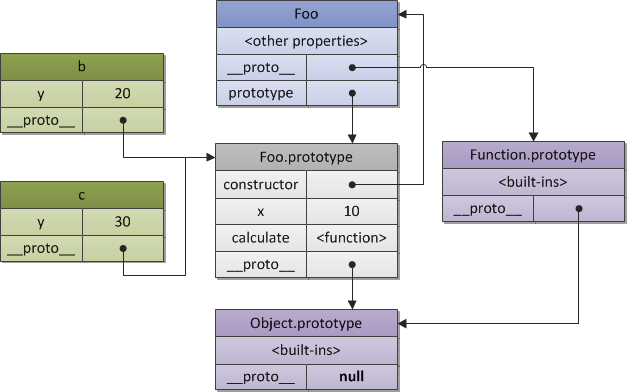
從上圖可以看出:每個物件都有一個原型;建構函數 Foo 自己也有一條 __proto__,也就是 Function.prototype,而 Function.prototype 的 __proto__ 又指向 Object.prototype。要特別區分的是,Foo.prototype 只是一個「顯式屬性」,而 b 與 c 的 __proto__ 才是實際的內部連結——兩者指向同一個物件。
這個主題完整說來有兩部分:一是物件導向的一般理論,描述各種 OOP 典範與風格,以及與 ECMAScript 的比較;二是 ECMAScript 的具體實作。了解物件原理之後,接著就是執行環境(runtime program execution),也就是所謂的「執行上下文堆疊」——每一個元素都可以抽象地看成物件。你大概也發現了,在 ECMAScript 裡幾乎處處可見物件的身影。
constructor 屬性詳解
物件的 constructor 屬性用於回傳建立該物件的函數,也就是我們常說的建構函數。
在 JavaScript 中,每個具有原型的物件都會自動獲得 constructor 屬性。除了 arguments、Enumerator、Error、Global、Math、RegExp 等特殊物件之外,其他內建物件(Array、Boolean、Date、Function、Number、Object、String 等)都具備此屬性,主流瀏覽器皆支援。
語法
object.constructor
回傳值
建立該物件的函數參照。
範例與說明
以下程式中的 [native code] 表示這是 JavaScript 底層的內部實作,無法顯示程式碼細節。
 // 字串:String()
var str = "張三";
document.writeln(str.constructor);          // function String() { [native code] }
document.writeln(str.constructor === String);  // true

// 陣列:Array()
var arr = [1, 2, 3];
document.writeln(arr.constructor);          // function Array() { [native code] }
document.writeln(arr.constructor === Array);   // true

// 數字:Number()
var num = 5;
document.writeln(num.constructor);          // function Number() { [native code] }
document.writeln(num.constructor === Number);  // true

// 自訂物件:Person()
function Person(){ this.name = "CodePlayer"; }
var p = new Person();
document.writeln(p.constructor);            // function Person(){ this.name = "CodePlayer"; }
document.writeln(p.constructor === Person);    // true

// JSON 物件:Object()
var o = { "name" : "張三" };
document.writeln(o.constructor);            // function Object() { [native code] }
document.writeln(o.constructor === Object);    // true

// 自訂函數:Function()
function foo(){ alert("CodePlayer"); }
document.writeln(foo.constructor);          // function Function() { [native code] }
document.writeln(foo.constructor === Function);  // true

// 函數的原型
function bar(){ alert("CodePlayer"); }
document.writeln(bar.prototype.constructor);   // function bar(){ alert("CodePlayer"); }
document.writeln(bar.prototype.constructor === bar);  // true
實務提醒
如果只用 constructor 來判斷型別,遇到跨 iframe 或改寫過 prototype 的物件時會失效,較可靠的做法是搭配 Object.prototype.toString.call(obj) 或 instanceof 一起使用。另外,__proto__ 屬於非標準的舊寫法,新程式碼請優先使用 Object.getPrototypeOf() 與 Object.setPrototypeOf()。
相關文章
-
JavaScript 中 in 與 hasOwnProperty 的差異詳解 JavaScript 繼承實作整理:從原型到 apply 綁定 用 JavaScript 建立類別與物件的四種寫法 JavaScript 以建構函式建立物件的經典模式 JavaScript 建立物件的多種寫法整理 JS Array 三大屬性與操作全解析:length 可變、prototype 擴充、constructor 判定 AJAX 框架與 JS 元件庫全面比較入門 常用的 AJAX 相關 JavaScript 方法整理 封裝一個可重複使用的 Ajax 類別:告別到處複製的請求程式碼 用 Ajax 做檔案上傳進度條:Java 版完整實作